



There’s a moment in qualitative research methods training that nobody warns you about.
You’ve done the interviews. You’ve sat across from people — or beside them, or on a call, depending on the day — and asked them to tell you things they don’t usually say out loud. About their work, their frustrations, the gap between what their institution promises and what it delivers. They’ve trusted you with that. You’ve recorded it carefully. And now you’re sitting with the transcripts, trying to figure out what you’re actually holding.
For me, the reckoning arrived sideways.
I’d been invited to review a manuscript for a journal that shall not be named here — the kind of task that sounds administrative until it isn’t — and the paper introduced me, properly, to the “Jeffersonian transcription system”. Not as a citation to manage, but as a problem to think through.
And the first thing I thought was: this is either the most precise tool I’ve ever seen, or it’s making a claim it can’t fully support.
It’s both, as it turns out. And the tension between those two reactions is what this piece is about.

The Notation That Sees Everything
Gail Jefferson developed her transcription system in the 1960s and 70s alongside the founders of conversation analysis. The premise is radical in its simplicity: if you want to understand how people talk, you have to transcribe not just what they say, but how they say it. The pauses — measured in tenths of a second. The overlaps, where two voices momentarily occupy the same space. The emphasis, the elongation, the sharp intake of breath before a difficult admission. The (.) that marks a micro-pause. The = that means the next utterance followed without a beat.
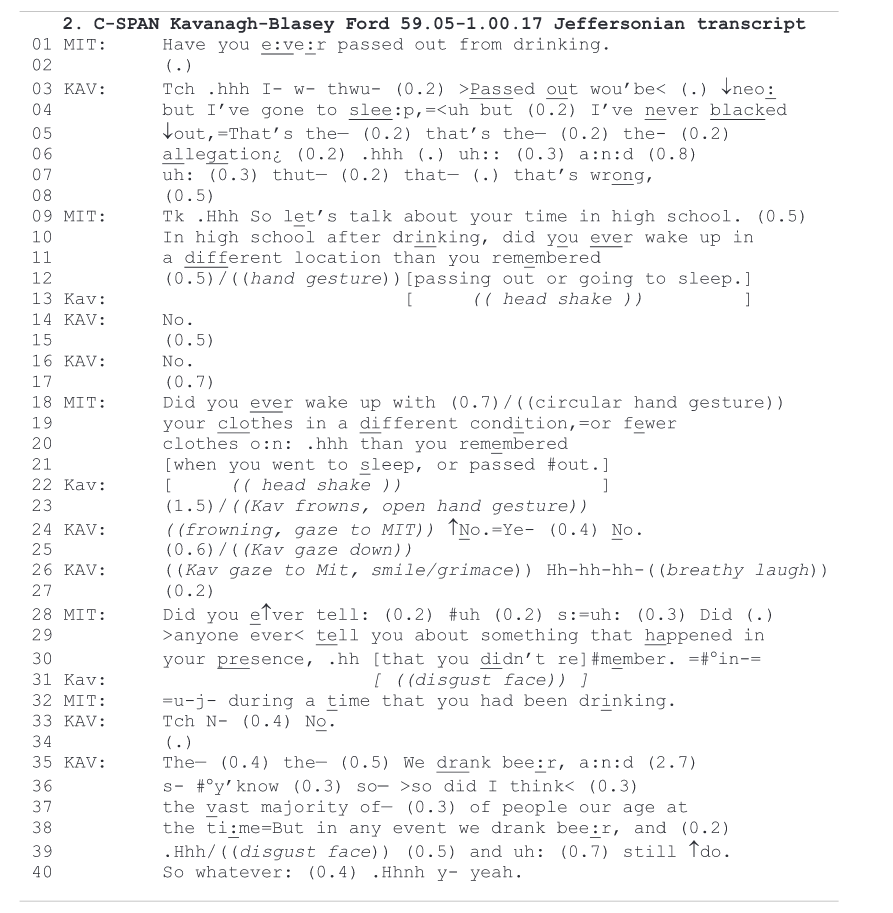
On the page, a Jeffersonian transcript looks like a score. Or a crime scene. Depending on your temperament.
Here’s why it matters: in research I’ve done with parole officers, the way people talk about their work turns out to be inseparable from what they’re actually telling you about it. Sarcasm. Irony. The pause that arrives just before someone admits something they’ve been asked not to say. The laugh that isn’t really a laugh. These aren’t decorative features of language — they are the data. Strip them out and you’ve got a cleaner transcript and a worse analysis.
Jefferson understood this. Her system is a serious attempt to solve a genuinely hard problem: how do you write down a conversation without killing it?
But here’s the question the manuscript review planted in me, and that I haven’t fully stopped turning over since: does exhaustive notation solve that problem, or does it smuggle in a different set of assumptions under the cover of precision?
